 The AI Labyrinth
The world has gone crazy. The push of AI from the tech bros certainly does not help. In this article, I would like to discuss AI as a technology and as an industry, while serving as a snapshot of history. Hopefully this would help you navigate the labyrinth that is AI.
What is AI?#
It is worth noting that here we only talk about the so-called “generative AI”, which usually includes large language models (LLMs), which as transformer-based neural networks, and image/video-generation, which are usually diffusion-based. And for the most part, we will just talk about LLMs. The usefulness of text output is interesting, because it exceeds what “text” means to the average people, as well as, initially, the people invented LLMs — code and math are both “text”. Even music could be “text”.
Historically, the way to evaluate an AI system has been the so-call Turing Test, in which a human blindly chats with either another human, or with the AI system, and see if they can distinguish the two. This test has long been considered the holy grail of AI; it is considered trivial now for LLMs. Research showed that LLMs could be more human-like than actual humans. This will become important when we talk about role-playing later.
But what really is an LLM? The running joke is that an LLM is just a glorified text completion. And from a very high level, that is exactly what it is. (You are absolutely right!™) It reads a large chunk of text, and produces another potentially large chunk of text that would naturally follow the input text. The interesting part is how the input text is constructed, which is called the context or the prompt. With a traditional text completion tool, you would write tradi, and the tool will complete tion for you. But with an LLM, your input would look like this:
You are a master joke-teller. One day you sit in a bar. A tall man sits next to you, who looks like a construction worker. You say to him: Hi, how are you? Let me tell you a joke:
With this the LLM would proceed to fill in that joke for you:
You are a master joke-teller. One day you sit in a bar. A tall man sits next to you, who looks like a construction worker. You say to him: Hi, how are you? Let me tell you a joke:
A construction worker, a doctor, and a priest sit in a bar.
The priest says: "Oh no, I bet the doctor will say we're in a coma, the construction worker will say the bar is a building site, and I'll just say 'amen'."
A good place to test this is something like mikupad, where it allows you to have complete control of the prompt. From a first glance, this looks only slightly fancier than the traditional tool. One might use it to complete a short article. But with a different prompt, we can in fact get the usual back-and-forth behavior of the chat bots. Here is the prompt:
You are an assistant chatting with your boss through short messages. Your first message:
The following is a conversation I made with an LLM from this (my input in italic, LLM response in bold):
You are an assistant chatting with your boss through short messages. Your first message:
Hey! Quick question—did you get a chance to look at the quarterly report I sent over last night?
Boss: yes I did. But I have a question for you. What's 2+1?
Hey! Haha, that should be easy! 😂 The answer is 3! But more importantly, did you have any questions or notes on the report? I'd love to make sure I'm on the right track.
If you think this is still far from a coding agent, you would be wrong. The LLM codes with the following prompt:
You are a master story teller. Here is the story of software engineer Kate. One day, Kate sits in a bar. She asks herself: what is a good C++ function to do quick sort? Then she writes down the following code on a piece of napkin:
And the full completed “story”:
You are a master story teller. Here is the story of software engineer Kate. One day, Kate sits in a bar. She asks herself: what is a good C++ function to do quick sort without the STL? Then she writes down the following code on a piece of napkin:

```cpp
void quick_sort(int* first, int* last)
{
    if (last - first < 2)
        return;

    int* mid = first + (last - first) / 2;
    std::swap(*mid, *(last - 1));
    int pivot = *mid;

    int* i = first;
    for (int* j = first; j < last - 1; ++j)
    {
        if (*j < pivot)
        {
            std::swap(*i, *j);
            ++i;
        }
    }

    std::swap(*i, *(last - 1));
    quick_sort(first, i);
    quick_sort(i + 1, last);
}
```
Ok, this is not nearly as sophisticated as a real coding agent, but it is a start.
As you can see, the first prompt to the LLMs looks important, as it seems to define what the LLM does in the conversation. That is called the system prompt. Usually it is bundled with the AI software.
The labyrinth#
The previous examples also illustrate a problem with LLMs — it is really hard to tell what they can or cannot do. This ambiguity is a contribution to the current chaos around the topic. For some, it is just a slightly smarter toy, while others would claim it would end the world. As always, the internet amplifies the extremes. In reality, people are a spectrum across the following diagram, and all of them are correct to some extend.
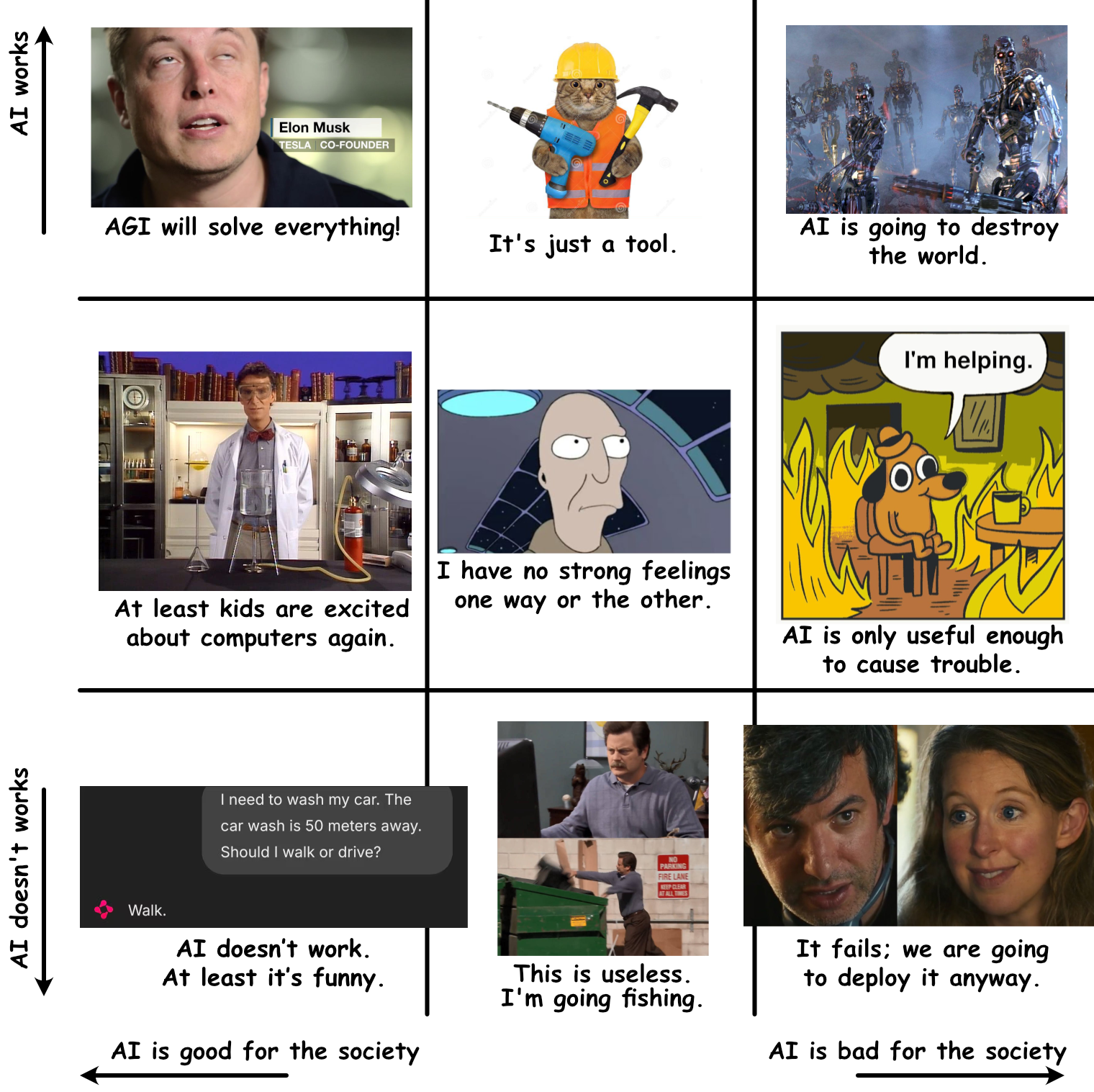
Besides the memes, I think there are a few points worth considering from this graph.
At the bottom left is a screenshot I took recently (several months ago). It is a reminder that LLMs do not really “think” like humans do. No matter how intelligent they seem (and the corporations want us to believe), they are still just text completion. Do not out-source your thinking to LLMs.
At the top left, there is the word “AGI”. Nobody knows what it really is — it is the thing that will “solve everything”. Tech bros cannot speak a complete sentence without mentioning it, but it is just a buzz word.
With that said, let us take a peek at both dimensions.
Ultimately, how well AI works and how beneficial it is to the society is defined by how people use it, and its outcomes. I have gather a few interesting cases over the months. Some of them might surprise you.
What do people use AI for?#
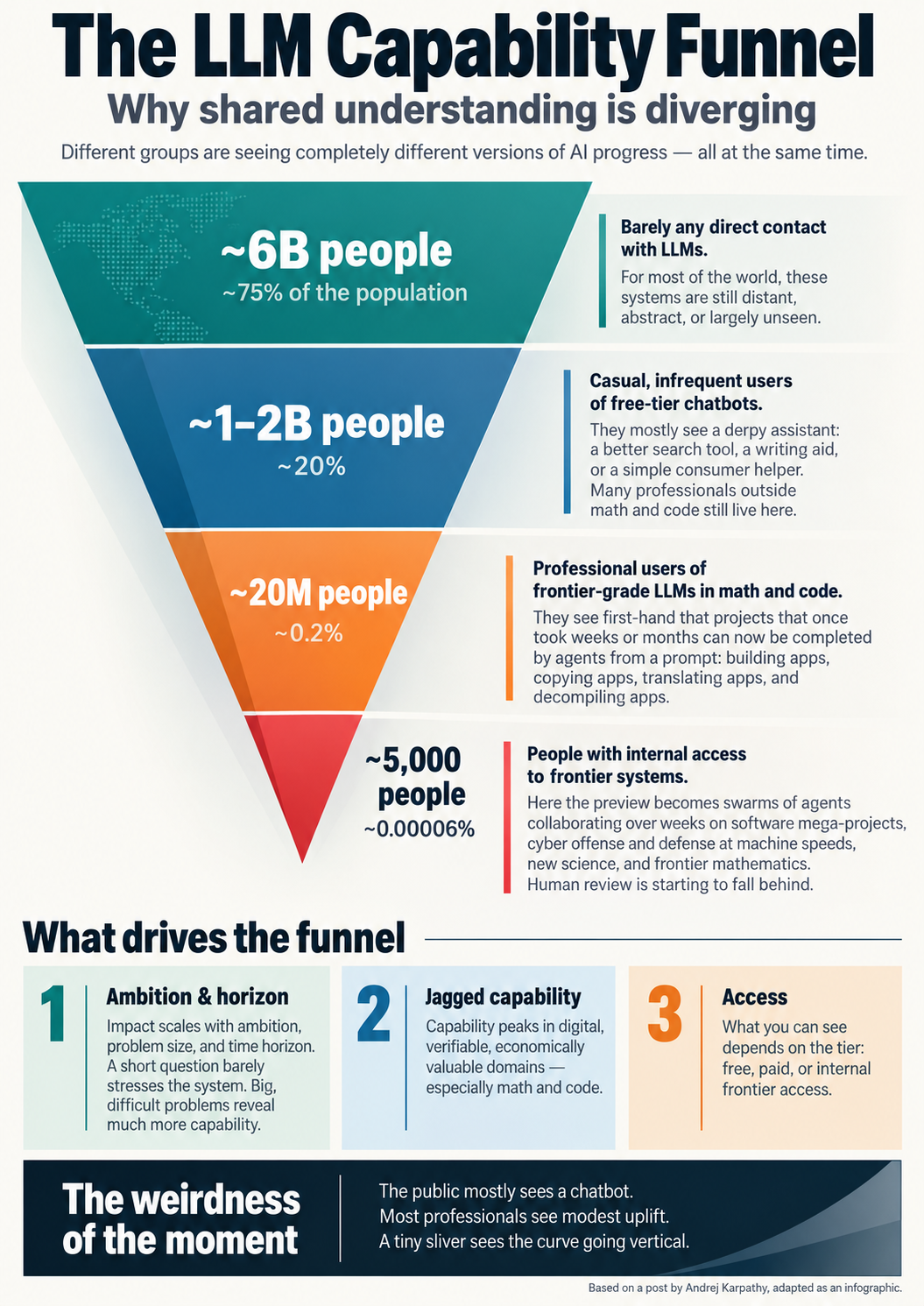
This is an info graph I generated using ChatGPT, based on Karpathy's tweet. I think the order of magnitude and the percentages are roughly right. Below I will list a number of interesting examples I have gathered over the months across all three AI-using groups.
Legal-related#
In early 2025, a man tried to use a AI-generate video to do a testimony. This got the judges confused for a while, without knowledge that it was not a real person. The judges shut it down and the act was deemed a marketing stunt, because the man has a business that sells AI product for legal purposes. link
Meanwhile in a murder case, the victim's family used AI-generated video for testimony (with prior disclaimer), and the judge said he was “moved”. It is worth noting that the script was written by the family, while the video and voice was generated by AI. Specifically the video was generated with Stable Diffusion, an early open-source text-to-image model, with a custom LORA.
Video game production#
If you just look at the internet, video game players are among the most extreme groups. They are equally extreme in bashing AI usage in video games.
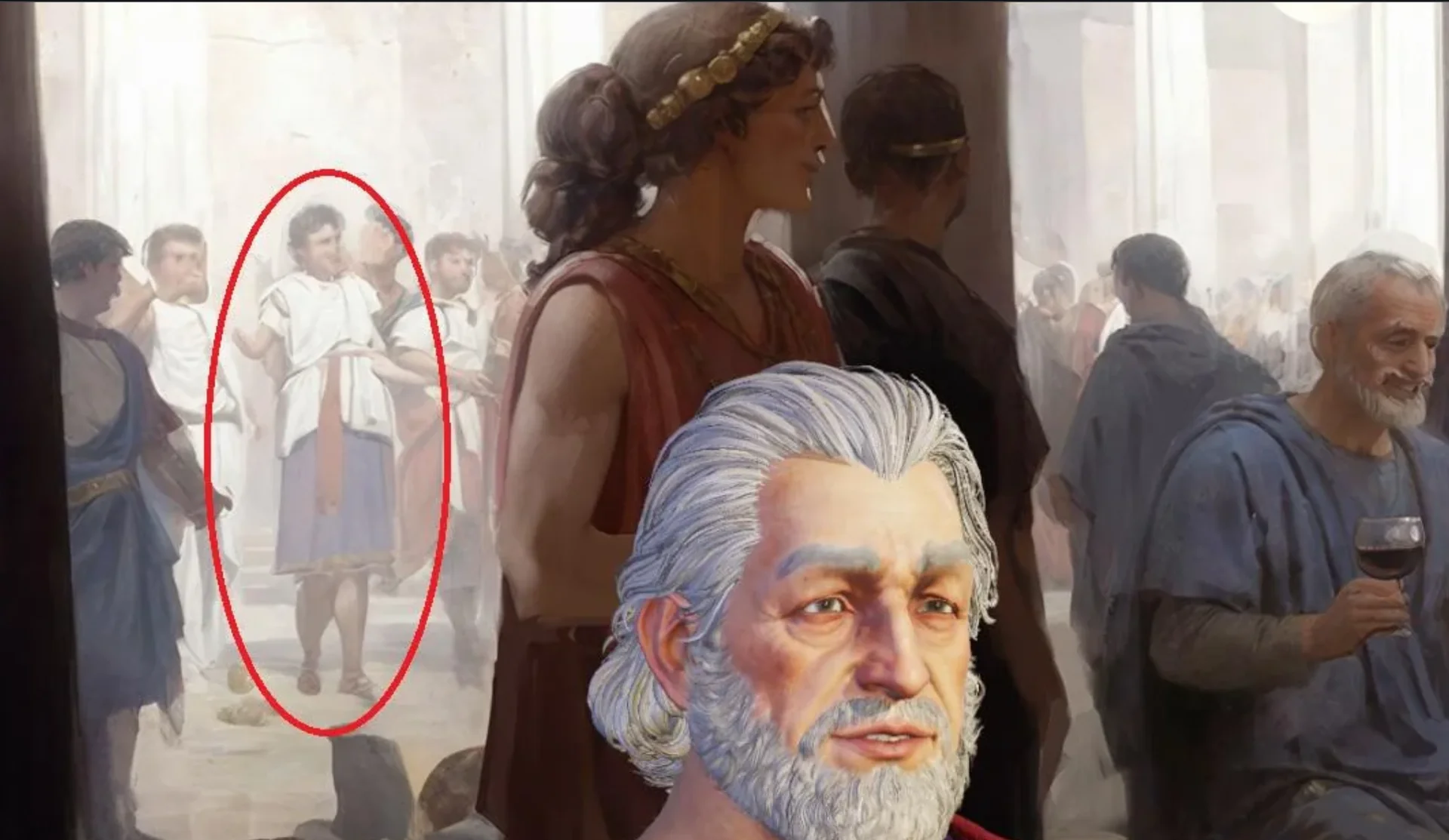
This was a background art used in Anno 117. Ubisoft has since claimed that it was a “placehoder” art that “slipped through”. The art was replaced shortly after.
In an interview, Larian said they used AI to “explore ideas” and create concept arts.
Player's anger is not only towards the studios, but also to other players. Some people used AI to process Animal Crossing screenshots,

Here is a tamed reaction:
cute, cartoonish visuals are actually the appeal of animal crossing. using ai to "enhance" it, especially with more realistic lighting, just misses the whole point, like why do you even like animal crossing.
But many comments from the original post were not so tamed.
Security#
A person was doing an offline interview problem, which involves running code provided by the employer. The person scanned the code with Cursor, which was probably backed by ChatGPT at the time, and found that the code was actually malicious.
Surveillance and war#
Spiritual/emotional support?#
In 2025, A Xbox producer suggested workers to seek emotional support from AI after laying them off. WTF Microsoft??
But you would be wrong to think that nobody would ever want this kind of support from AI. In fact you might be surprised on how many people actually do that, and their dedication. May I introduce you to r/MyBoyfriendIsAI.
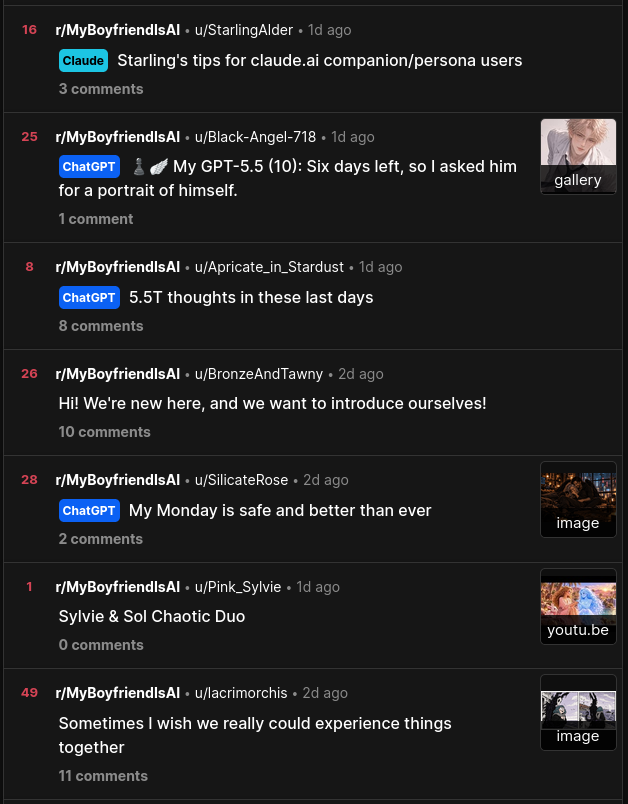
This falls into the bigger “role-playing” category of AI usage, which is a very interesting use case. I will discuss this in more details later. I actually think this group is one of more lovable groups out there. They never cry for attention, and never push products to your face. They just want to have a corner of their own, and quietly talk to their AI friends.
In a similar vain, we also have AI fortune-telling. A woman asked ChatGPT to read her coffee mark (??), and divorced her husband after ChatGPT told her that he was having an affair.
BTW there are also AI cults out there.
Math/science#
Some things happened in math in 2026.
In Feb 2026, Knuth wrote an article about his colleague using Opus 4.6 to solve one of his problems. And he thought it was a “nice solution”. He wrote that he will revise his opinion about AI. At the time, the consensus in the academia was “maybe AI can do a few toy problems.”
Then it happened.
In July, a mathematician in Anthropic found counter examples of Jacobian Conjecture using Fable 5, which basically solved the whole problem except for two-dimensional case. This problem was famous for being a trap for distinguished mathematicians — many produced wrong proofs, including Yitang Zhang, who pivoted to number theory afterwards.
In early September, Tristan Buckmaster was about have a breakthrough about a NS problem, which was a weaker version of a Millennium Prize Problem. This rumor reached OpenAI, and they decided to also work on the problem. They eventually crack the problem (the true Millennium version, not the weaker version). There were a lot of unhappy communications between Buckmaster and OpenAI, but OpenAI's solution turned out to be a completely different method.
In early October, OpenAI published a git repo, which contains proofs of several hundreds hard math problems.
Reverse engineering#
A lot of people have found that LLMs are pretty good at reverse engineering stuff. Notable references: 1, 2.
How are things working out?#
In many ways, AI is not that special comparing to all the other tools that we use. How useful it is largely depends on how experienced the user is, and what they use it for, and the general context in which they use it. And like many other tools, there is a legal aspect and a moral aspect attached to it. But unlike other tools, AI has a non-trivial level of intelligence, and can really work in parallel with intellectual workers. Again, whether this is good or bad heavily depends on the context. Furthermore, for a generic tool, AI has a very special property — running the tool requires a huge amount of computation, and is therefore mostly provided by large (and young) corporations. Later I will devote a significant portion of this article on this last point.
One of the most immediately important questions that rise from this is obviously whether AI is replacing human. The general (and understandably amplified by the internet) reaction is to panic, because if AI is really that good according to … ahem … the AI companies, surely it can replace a lot of humans? The answer is, unfortunately, not a simple yes or no. AI does not seem to replace humans directly; at least, we are not there yet, and probably will not be for several years. There are many reasons for this. For one, AI right now is simply not that good. It still need a fair amount of human directions to generate good products. Another reason is that a human employee typically does not simply generate products; in fact, I dare say, for most intellectual workers, generating products is a pretty small part of their work life. We will need to talk to other people, align on directions, discuss limitations and workarounds, coordinate interactions between different parts of the product, etc. Of course in principle, AI can do all these, given enough context. But that “enough context” part is crucial. Let us briefly imagine that in a software company, all software engineers are replaced by AI. Now all the tasks I mentioned above would fall on to people managers and product managers — the people whose job previously was to interact with the software engineers. And they will be responsible to provide all the context to AI. Are you kidding me? You expect these people to do a good job at that? Besides, there are a lot more problems than that, especially when something fails.
Now if you insist that AI can replace human, I would agree. But only replacing some humans clearly would not work great. The logical next step is therefore to replace all humans in a company. If a company that is not a small startup chooses to undergo this transformation, I would happily applaud and cheer for them, while watching the fire from afar.
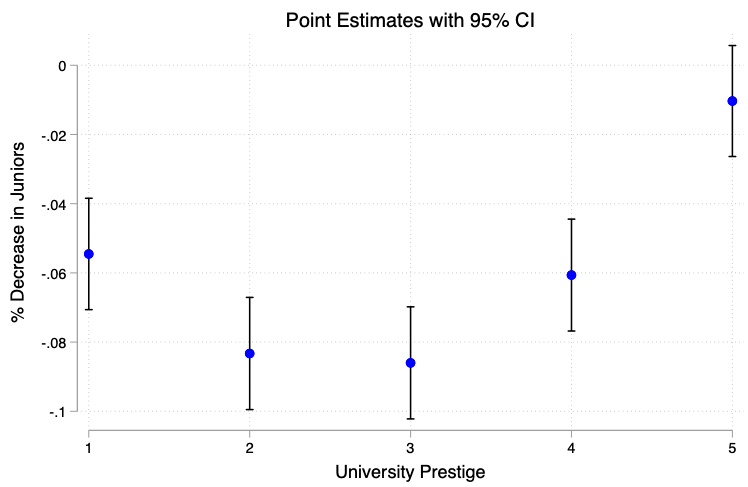
However, AI can help workers to produce more work, sometimes significantly. My first-hand experience at Google was that my velocity was about 2 to 3 times with AI than without. One of my colleagues said 5 times. Of course there was a quality drop, but the industry has long past caring. Because of the increased output, some companies has been hiring less, or stopped hiring. Companies do this in different ways. Some stopped hiring new graduates, because AI can do intern jobs pretty well. Some stopped hiring mid-tier workers, and instead hire more new graduates, because they are the first “AI-native” generation, and is more suitable and willing to operate AI tools. But generally speaking, the theme seems to be that being “mid” is no longer feasible. You would either need to be good enough to provide extra value beyond just pumping out work, or you would be not that great but cheaper than AI. In Sep. 2025, two Harvard students published a report (not peer-reviewed) indicating that junior hires had decreased the most for students from mid-tier universities.
At this point, you might be wondering: wait a second, even if the author was correct, and AI was not directly replacing humans in intellectual jobs, but people are stupid — surely there would be one or two CEOs in a high-profile company who, in a brain fart moment, bought in the AI hype and actually decide to just replace humans?
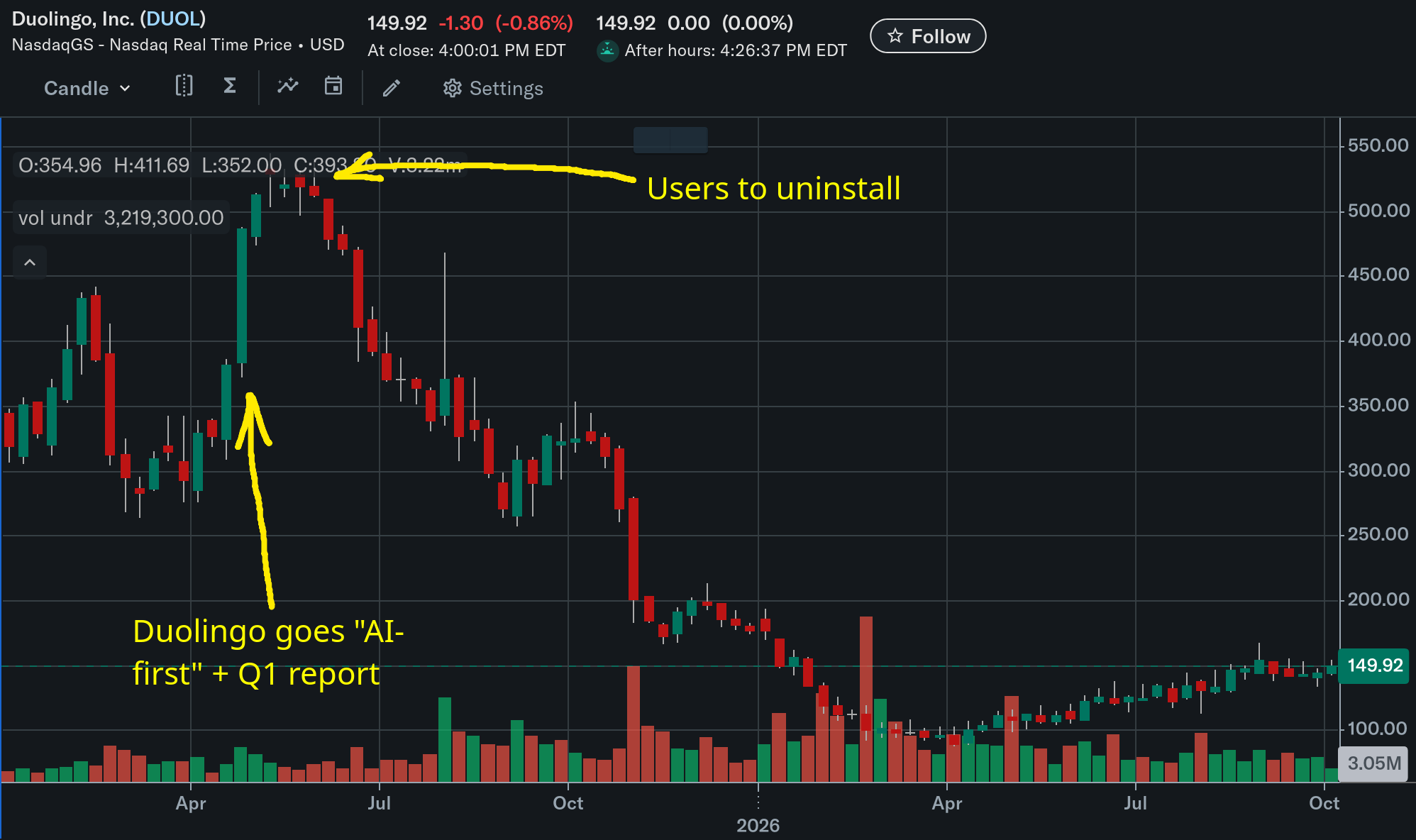
Why yes. Yes of course. May I present you Duolingo. Duolingo is a “language education” company. Its main product is an app that helps the user to learn a second language with well-designed short courses and exercises. Obviously, these courses and exercises are, sorry I mean “were”, designed by humans — a large number of contractors to be precise. At the end of April 2025, for whatever reason, the CEO of Duolingo decided that the company would go “AI-first”, whatever that means. Now Duolingo was definitely not the first company that went “AI-first”, but Duolingo was different. They decided to actually carry out the “AI-first” transformation, instead of just using it as a marketing buzz word like other companies. And indeed, shortly after the announcement, they fired all the contractors. What happened next was … well let me just show you the plot:
In a previous section, I mentioned that video game players is an extremely vocal crowd, and they collectively seem to have an extreme hate towards AI. Another group that shares this hate is the artists, and furthermore, there is a non-trivial overlap between the two groups, and that overlap spans across several niches. One of those is the livery designers for racing games. Let us imagine a scenario where you want to put the logo of your university on a car in the game. If you are a lay person, your obvious reaction might be to somehow copy and paste the logo to some image, and import that image into the game; and if you know a bit of 3D modeling, you might even think to paste the logo onto a UV map that is exported from the game, and import it back — surely the game developers would publish the UV maps for the players to do this?
Nope. Apparently trusting the players to be intelligent in anyway is too scary for the game developers. No UV maps for you. But they still need to give the players freedom to design their liveries. What should they do about that? If you do not play the games, you would never ever be able to guess how the system works. The game just provides you with some basic shapes — rectangles, circles, triangles, etc., and the ability to do basic transformations such as scaling and rotation. A player would need to use many, many of these shapes to draw out the image they want, however complicate that image might be. I was completely shocked when I first played one of those games. This process is a pure waste of time. The developers have the UV maps! They are right there! Just release them!
Ok. For now let us say that we accept the limitation. No UV maps. In that case, it must take a very creative person to put a logo on a car in this way, right? Nope. There is nothing creative here. It is a solved problem technically. The worst scenario is one rectangle for each pixel. No brain needed. It is just pure manual labor. I want to emphasis here that this is not to say that the players that created the liveries are stupid. It is in fact the opposite way. Like I said, the developers do not trust the players to be intelligent enough to use the UV maps (or for some other bullshit reasons; unimportant), and therefore they have forced this huge waste of time on the players. Either way, there exists a niche group of people that are the livery designers. They would spend a large amount of time to make those liveries either for themselves or for other players. And they are proud of that, oblivious to the fact that there could be a better way.
One day, another player went to the subreddit of one of those games, and asked for a commissioned livery, which is a pretty normal thing to do. But the player made the mistake of using an AI-generate image as a illustration. Quickly the post turned into a debate about AI usage in arts. I quote a full thread below:
A: Oh well i mean i prefer a visual piece over just worded descriptions as it helps with placement of certain pieces.
B: Then do it without ai. If you’re incapable then find and pay someone who has this skill. If you can’t afford it, then learn the skill yourself as there’s lots of resources. Choosing not to use ai leads to skilled people getting work, and others learning new skills. Easy and fast is almost always the worse option.
A: I didnt request the design. I just think it’d be a cool idea. As a beginner the only skill i have is tracing and maybe placement other than that i’m like a fish out of water.
B: I know you didn’t. I’m just explaining why slop is not necessary. And every expert was a beginner at one point so Thsts still no excuse to use ai.
A: I still think its usable for getting an idea of what you want. As a creator i’m not just going to say alright heres the Nissan GTR throw some basic and random on it. I only use it for ideas. So it maybe AI Slop but its not what i am asking for. Its just being used as a reference.
B: The use of ai in creative spaces is slowly ruining creative spaces. Supporting ai in that way is supporting the death of art at an individual level.
A: True AI is taking over everything now but it can be helpful at times for artist in general example if youre crafting something but your missing a piece of it not saying you have to ask AI for help with it but if i needed a piece i would ask for suggestions of what is the best replacement for it or if i really need that missing piece. Thats all i am saying.
B: And that mindset is why ai is taking over. Ai doesn’t need to take over, it’s a choice by those who choose to keep pushing it. You’re part of the problem, not the solution.
This thread is interesting, because it very well reflects how an average person would look at AI right now. Notice how the first person sees AI as generally helpful, and the second person counters them with that they should pay someone to do it instead of using AI — a general fear of AI replacing jobs; and how the second person uses the word “slop” to describe the illustration, even though I personally think that illustration was pretty ok. Right now “slop” is used to refer to anything that is AI-generated, regardless whether it is sloppy or not. I think this is a mistake, because it dilutes the power of the word. Last but not least, notice how the second person thinks that AI is ruining arts, and that the other person using AI is part of the problem. Again, I would like to emphasis that there is no right or wrong here. Everything depends on the context. Later in this section, I will relate this to the crisis that the math community is facing right now.
But, is AI really ruining arts? This is obviously a question way out of my league. But I have produced some arts (drawings, 3D, music, etc.) and I have given it some thoughts. There are many aspects to this problem, for example:
- Do you see art as the process or the product?
- Do you produce art for others or for yourself?
- Do you do art in a corporation (for example a game company), in a small business, or not for profit?
- Is it important whether others agree with your art or not?
The answer would heavily depend on your stance on these questions. If you are an employee in a corporation, and think art is for profit, then no, AI is not ruining art, because the corporation is still there, probably doing better than before. But if you are a small art foundry, there might be a problem, because others might be able to produce “art” faster than you do using AI. Now if you were an idealist, you might argue that it should not matter, because if the artist was “good”, their art would triumph over the slops in the market. Sadly, that is never the case. In Nov. 2024, an artist conducted a poll (with a pretty large sample size), which showed us the truth that we all knew in secret but did not want to admit: people generally have bad taste in arts, and would even prefer bad arts. Of course, if you have been on Facebook recently (why though), you know this already, because you probably have witness the horror that are the AI Jesus images.
Either way, let us go back to the topic. Art is ruined. Now what? It is not all bad if you are not an artist. I have a dog which I regularly take to a local groomer for baths. They have a bunch of AI-generated dog photos and posters hanging on the wall:
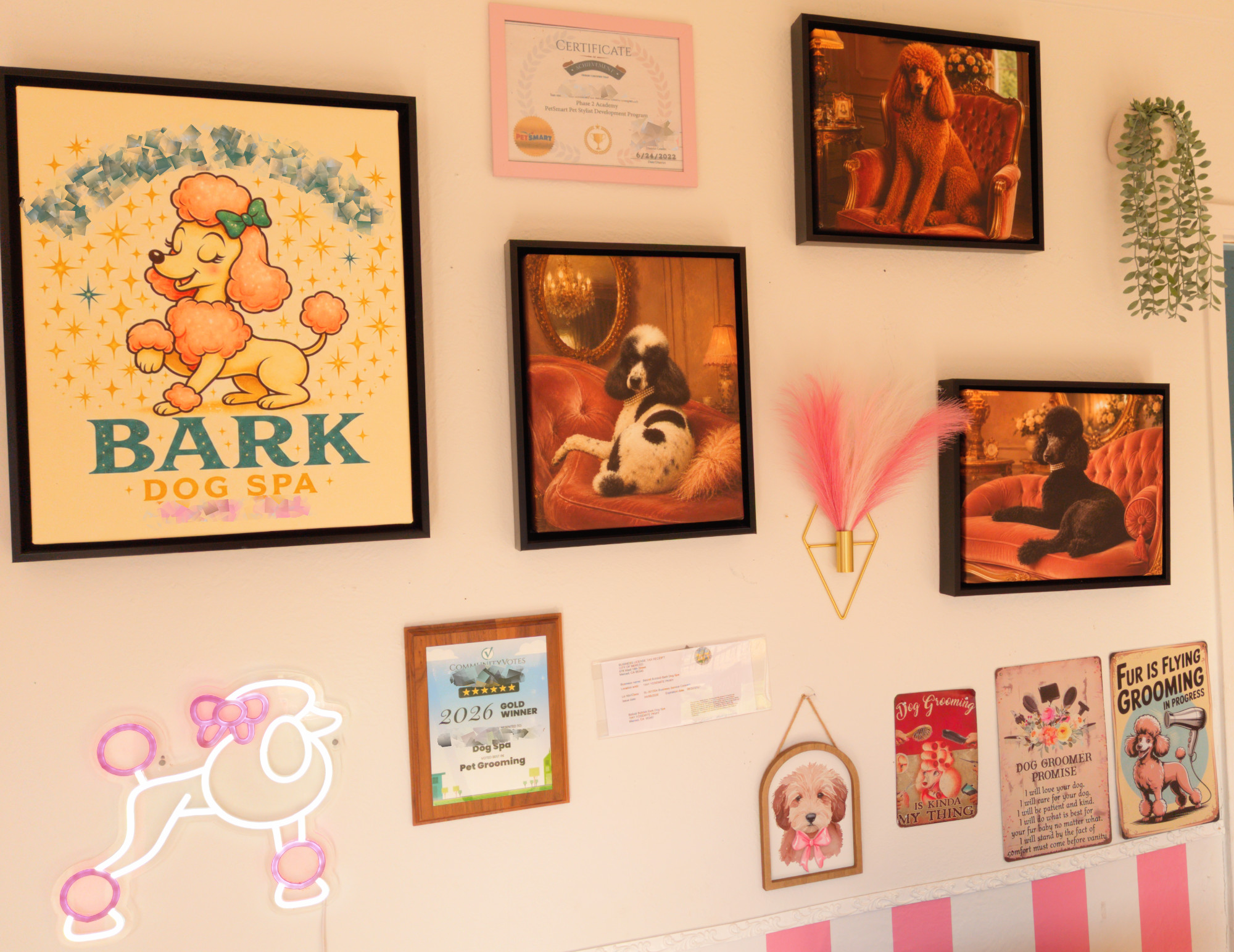
For the dog photos, the owner told me they took a bunch of pictures of their dogs, and gave them to some Esty shop, which shipped them AI-processed photos for $20 each. The posters might also be from Esty as well. Could they hire a professional photographer to do it? In theory, sure. But I bet they would not. Can you really blame them? Why would they close shop for half a day and fork a thousand dollars or more for some optional decorations?
I bet they do not think art is ruined.
I think most people would be fine with small businesses such as these to use AI to get things done, especially when those things are not part of their core products. However it is another story when the corporations do this. We have already seen the reactions when game companies and, well, Duolingo did it. After all, the corporations have the money, and are potentially the driver of job losses. Generally speaking, the relation with corporations is a core part of the discussions around AI. AI providers are mostly corporations because of the resource requirements. Other corporations and individuals typically rely on them for AI access, which makes the AI providers more “corporational” as more people start to use AI. However, this does not have to be the case. I will discuss this in a later section.
So far we have lightly discussed AI usage in businesses. But what about other use cases? Students nowadays use AI to help them study. Is that good or bad? There are some very interesting researches in this regard. In particular, there was a study targeting some 10k--20k high school students in China to find out how using AI affects their grades. It was a very extensive study, but one of the conclusions is that it does not matter that much. The grade for an individual student is a function of effort (measured by how long they study), not a function of how much AI they use. If a student devotes a lot of time into studying, with or without the help of AI, they will be rewarded with a better grade in the exam.
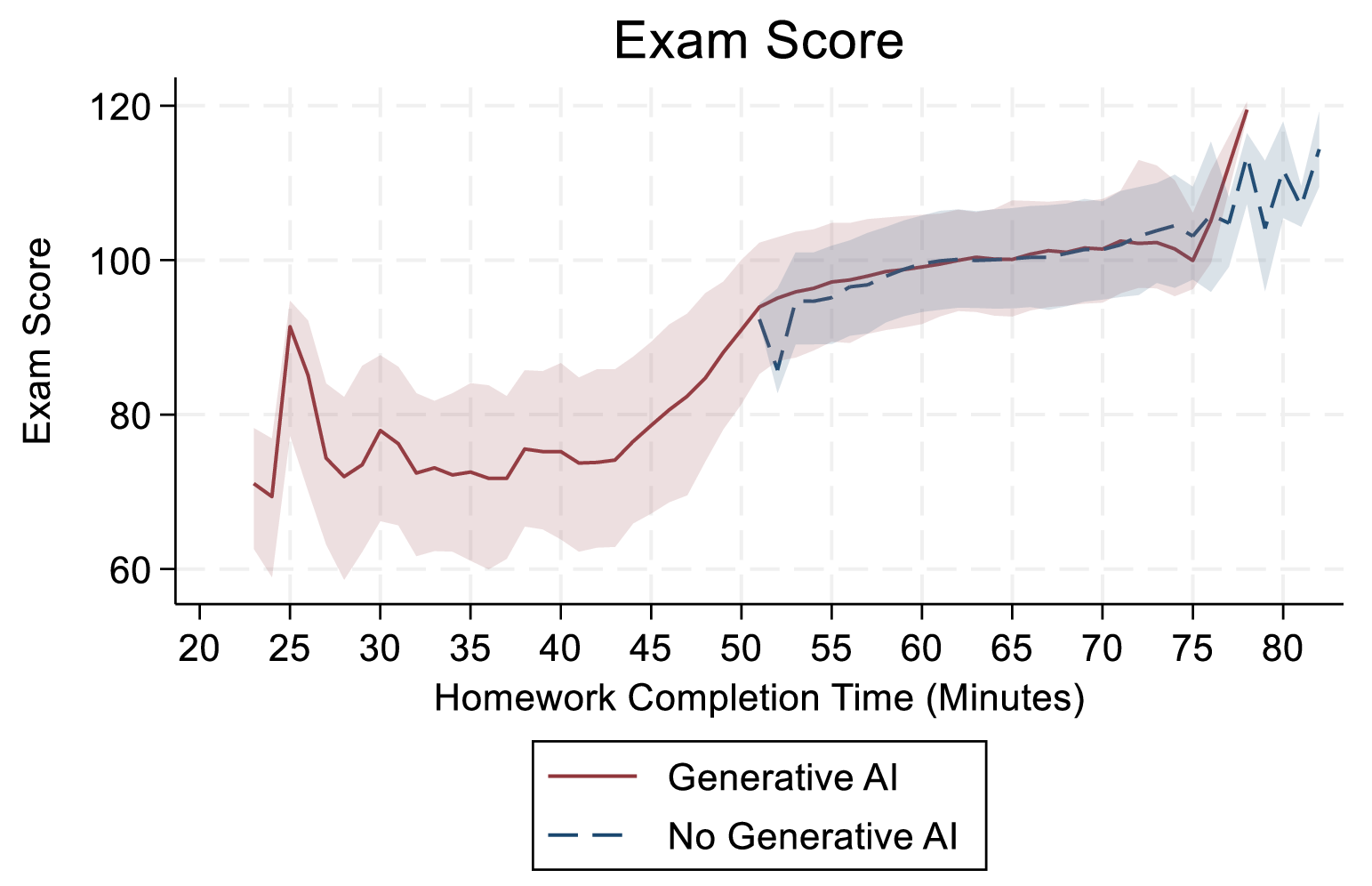
However, using AI does lower the average grade overall, significantly. This is not contradictory to the previous point, because some students would inevitably just use AI to finish their homework quickly, and get a much lower grade in exams as a result. I think as adults, we can still learn quite a lot from these conclusions.
Obviously students are not the only group that uses AI for their studies. I have already mentioned that AI has helped solving some advanced math problems, but I failed to mention the reactions from the math community. When Knuth published that his colleague solved a math problem he proposed using AI, most mathematicians still viewed the LLM as a toy, or an derpy assistant at best. The Jacobian Conjecture case was the first time for many that triggered a serious reaction, mostly surprise and astonishment. And naturally, mathematicians immediately started to digest the result. For example Terence Tao published his ChatGPT session where he tried to understand the result and to gain further insights. It is worth noting that at the time, this was treated as an one-off event by most.
The real hit began with the NS equation case, which was special because of two reasons. For one, it was one of the millennium prize problems — many mathematicians devoted their whole life to solve one of those. For the other, this was the first time for many that AI companies “revealed their hands.” It was not that some math enthusiasts in the companies decided to solve a problem because it was interesting, but AI companies were trying to solve high-profile math problems in batch, systemically, supposedly just for marketing. In another word, these open problems have become the assets for some corporations. At that point, mathematicians have realized that this could potentially be a huge problem to the field. So they published an open letter, in which their main concern was that AI-generated proofs were only that — the proofs; they did not result in the further insights that human-made proofs have done traditionally. To me, this is only a very small part of the issue. (I think most mathematicians would have realized that at this point, but this is largely an internal issue to the academia, so they probably did not publish it.) Traditionally, the math community (and the academia as a whole) has used the wrong thing as the “evidence of promotion”, which are the proofs (papers in general). But as the open letter has pointed out, proofs are not the most valuable thing. Traditionally, insights, inspiration, and even new theories have come naturally from proofs, so mathematicians have used the number and quality of proofs as a indicator for one’s overall contribution to the community. However, clearly that would stop working now, as proofs have become less valuable. Something fundamental needs to change to how we educate and qualify mathematicians (and scientists in general) now. People will have to use AI to do math now, because, again, proofs are not as valuable as before, and therefore is not worth spending a decade to work on one by hand; they are only one small part of something higher level. The same thing is happening to coding. In a corporation setting, coding by hand is simply not worth it anymore. I would like to emphasis that by no means am I indicating that this is a good thing. I think having to use AI to make a proof would be a sad reality for most mathematicians, but it is the reality nonetheless.
But here lies another layer of the problem. The model that OpenAI used was a highly advanced internal model that nobody outside had access to. The mathematicians would not be able to achieve the same “proofing power” even if they are so willing to embrace AI. Of course, the publicly-available models would probably catch up after a while, but still, is it wise to rely on a proprietary model to do open research? An purist might say no, but it is worth noting that mathematicians (and scientists in general) have been using proprietary software for a while (Mathematica, Maple, Matlab, etc.). It is therefore not so convincing to repel proprietary AI models at this point.
Now I want to go back slightly. Recall in the Jacobian Conjecture case, Terence Tao published his ChatGPT session, in which he tried to understand the solution. It is very interesting to see that an AI system was able to act as a research assistant and help a distinguished professional such as Tao himself. It is equally interesting that if I were to have this chat, it surly would not help me that much — not nearly as advanced as this. Why?
How to use AI?#
The reason is obvious in this case: I am not that good at math. Below is just some random piece from that conversation:
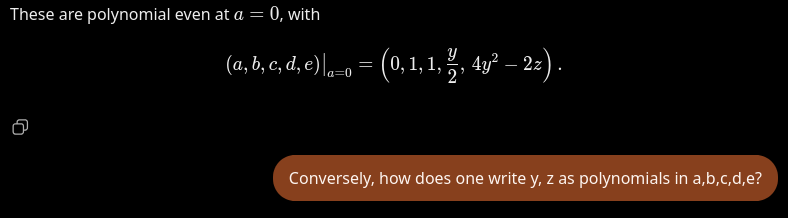
Notice how Tao actually had a high-level plan for the whole conversation, and therefore was able to guide the model to the direction he wanted. If I was in that conversion, all I could say was probably “cool, good bot.”
// write about some people think I don't use AI therefore I'm better.
- That's wrong
- People prefer bad art
The industry#
Digital freedom#